Flowers, Feelings & the Bach Flower Remedies 🌿

A Gentle Introduction to Flower Essences

There is something fascinating about the long relationship between people and plants.
We have gathered plants for food, medicine, fragrance, beauty, ritual, and companionship for thousands of years. Sometimes that relationship is highly practical. Other times, it is more difficult to explain.
The Bach Flower Remedies fall into that second category.
Developed in the 1920s and 1930s by English physician Dr. Edward Bach, the system consists of 38 individual flower and plant essences, each associated with a particular emotional state or pattern of feeling.
Flower essences are still used today as a complementary wellness practice by people who are interested in emotional balance, self-reflection, and traditional plant-based approaches to wellbeing.
I have used Bach Flower Remedies myself, including Rescue Remedy, and I find them to be a useful part of my own wellness toolkit. That personal experience is one reason I wanted to introduce you to the system.
At the same time, it is important to understand what Bach Flower Remedies are, what they are traditionally used for, and what modern research has and has not shown.
Who Was Dr. Edward Bach?
Edward Bach was born in Birmingham, England, in 1886. He studied medicine at the University College Hospital in London and qualified as a physician in 1912.
His early career was very different from what we might picture when we think about flower essences.
Bach worked as a physician, pathologist, and bacteriologist and conducted research involving vaccines. He eventually became interested in homeopathy and worked at the Royal London Homoeopathic Hospital beginning in 1919.
Over time, however, Bach became increasingly dissatisfied with an approach to medicine that he felt focused too heavily on disease and not enough on the individual person.
He became interested in the relationship between emotional states and overall wellbeing. Eventually, he began looking for gentler plant-based preparations that could be associated with different emotional patterns.
In 1930, Bach left his successful medical practice in London and devoted himself to finding and developing his flower remedy system.
He traveled through England and Wales with his assistant, Nora Weeks, spending much of the warmer months searching for plants and preparing remedies. During the winter, he worked with people using the remedies he had developed.
In 1934, Bach and Nora Weeks moved to Mount Vernon in the Oxfordshire village of Brightwell-cum-Sotwell. It was there, in the surrounding countryside, that Bach discovered the remaining remedies needed to complete his system of 38.
Bach died in 1936 at the age of 50.
His assistants, Nora Weeks and Victor Bullen, continued his work after his death, helping to preserve the system and establish the Bach Centre, which remains associated with his work today.
One of the interesting things about Bach's story is how much his philosophy changed throughout his life. He began as a scientifically trained physician and researcher, but eventually moved away from laboratory-based medicine toward a system based on his observations, intuition, and his belief in the energetic qualities of plants.
That distinction is important when we talk about Bach Flower Remedies today.
What Is a Flower Essence?
A flower essence is not the same thing as an essential oil.
Essential oils contain concentrated aromatic compounds extracted from plants. Flower essences, in contrast, are extremely dilute preparations traditionally made by placing flowers or other plant material in water.

Bach used two basic preparation methods.
The sun method involved placing freshly picked flowers in spring water and allowing them to sit in sunlight for several hours.
The boiling method was used for some trees and plants, where plant material was boiled in water.
The resulting liquid was filtered and preserved, traditionally with brandy. It was then further diluted to create the remedies used by practitioners and consumers.
The traditional Bach philosophy is that the preparation captures the "essence" or energetic quality of the plant. Each essence is then associated with a particular emotional state.
From a modern scientific perspective, however, these preparations are generally so dilute that they contain little or no measurable amount of the original plant material. Research has not established that Bach remedies have effects beyond placebo.
That doesn't mean someone's experience of using one is meaningless.
A person may find value in the ritual of pausing, identifying how they are feeling, choosing an essence that reflects that experience, and intentionally taking a moment for themselves.
For me, that is one of the more interesting aspects of flower essences.
They invite us to pay attention.
The 38 Bach Flower Remedies
Bach organized his 38 remedies around different emotional states and patterns of experience. The descriptions below are simplified summaries of the traditional Bach system, rather than medical indications.
For Fear
1. Rock Rose Traditionally associated with terror, fright, or feeling overwhelmed by fear.
2. Mimulus For specific, recognizable fears, such as fear of illness, accidents, being alone, or other everyday concerns.
3. Cherry Plum Traditionally associated with fear of losing control of one's thoughts or actions.
4. Aspen For vague or unexplained fears where you may not know exactly what you are afraid of.
5. Red Chestnut For excessive worry about the safety or wellbeing of people you love.
For Uncertainty
6. Cerato For second-guessing yourself and repeatedly seeking reassurance from others.
7. Scleranthus Traditionally associated with indecision, especially when going back and forth between choices.
8. Gentian For discouragement after a setback or disappointment.
9. Gorse For feelings of hopelessness or having given up hope.
10. Hornbeam For mental weariness and the feeling of not having enough energy to get started.
11. Wild Oat For uncertainty about direction, purpose, or which path to take.
For Lack of Interest in the Present
12. Clematis For daydreaming, being absorbed in the future, or feeling disconnected from the present.
13. Honeysuckle Traditionally associated with dwelling on the past or longing for what once was.
14. Wild Rose For resignation, apathy, or a sense of simply going along without much engagement.
15. Olive For feelings of exhaustion following prolonged effort.
16. White Chestnut For repetitive thoughts, mental chatter, or thoughts that seem difficult to quiet.
17. Mustard For periods of deep sadness or gloom that seem to arrive without an obvious reason.
18. Chestnut Bud For repeating the same patterns or mistakes without seeming to learn from the experience.
For Loneliness
19. Water Violet Traditionally associated with people who are independent and self-contained and may have difficulty letting others in.
20. Impatiens For impatience, irritability, or frustration when things aren't moving quickly enough.
21. Heather For people who are very focused on their own concerns and strongly seek the company or attention of others.
For Those Over-Sensitive to Influences and Ideas
22. Agrimony For hiding inner worries or distress behind a cheerful exterior.
23. Centaury For difficulty saying no, setting boundaries, or putting your own needs alongside those of others.
24. Walnut Traditionally associated with periods of transition and the desire to remain steady despite outside influences.
25. Holly For feelings such as jealousy, suspicion, anger, or resentment.
For Despondency or Despair
26. Larch For lack of self-confidence or the expectation of failure before trying.
27. Pine Traditionally associated with guilt, self-blame, or feeling responsible for things that may not be yours to carry.
28. Elm For feeling temporarily overwhelmed by responsibilities.
29. Sweet Chestnut For a sense of extreme emotional anguish or feeling that you have reached your limit.
30. Star of Bethlehem Traditionally associated with the effects of shock, grief, or distressing experiences.
31. Willow For resentment, bitterness, or feeling that life has treated you unfairly.
32. Oak For people who keep going despite exhaustion because they feel they must carry on.
33. Crab Apple Traditionally called a cleansing remedy and associated with negative feelings about oneself, perceived imperfections, or a sense of being unclean.
For Over-Care for the Welfare of Others
34. Chicory Traditionally associated with possessiveness, overprotectiveness, or needing to feel needed.
35. Vervain For intense enthusiasm, strong convictions, or difficulty relaxing around something you care deeply about.
36. Vine For people who are highly confident and may become controlling or inflexible.
37. Beech For criticism, intolerance, or becoming overly focused on the faults of others.
38. Rock Water For people who place very high demands on themselves and may be overly strict or rigid in their personal standards.
These traditional descriptions come from the Bach system and the descriptions maintained by the Bach Centre.
Crab Apple: A Particularly Interesting Remedy
Crab Apple caught my attention for another reason.
If you have been following my weekly Nordic Inspired Seasonal Ingredient newsletter, you may remember that Crabapple was my Week 37 seasonal ingredient.

I spent that week looking at crabapples as a food, including their history, seasonal availability, culinary uses, and my own memories of the crabapple trees I knew growing up in Oregon.
But the crabapple has another interesting place in traditional wellness.
Within the Bach system, Crab Apple is associated with feelings of imperfection, uncleanliness, or discomfort with something about oneself. Bach traditionally described it as the "cleansing" remedy.
I find this particularly interesting because it gives us another way to look at a plant.
A crabapple can be a tart little autumn fruit, something you might turn into jelly, cider, sauce, or preserves.
It can also be part of a traditional flower essence system that uses the same plant as a symbol associated with how we perceive ourselves.
Those are two very different relationships with the same plant.
And this is one of the reasons I enjoy exploring seasonal ingredients beyond their nutritional value. Plants have stories. They have cultural associations. They have histories of use that sometimes overlap with food, herbal tradition, folklore, craft, and personal meaning.
Crab Apple is a lovely example of that intersection.
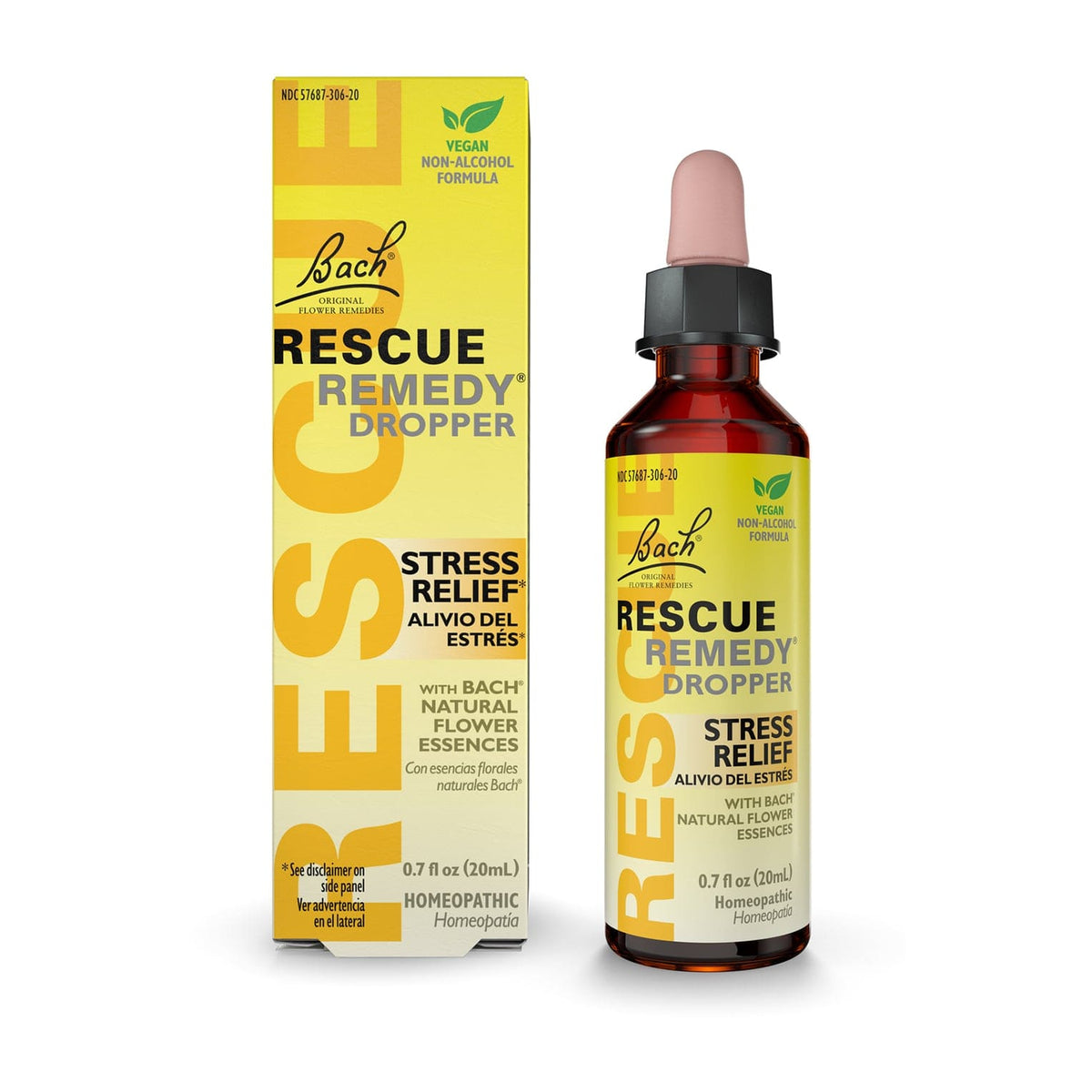
Rescue Remedy: An Emotional First-Aid Tool
If you have ever browsed a natural foods store, you may have seen Rescue Remedy.
It is probably the best-known Bach Flower combination.

Unlike the individual 38 remedies, Rescue Remedy is a combination of five Bach remedies:
Rock Rose
Impatiens
Clematis
Star of Bethlehem
Cherry Plum
Bach developed this combination for situations involving acute stress, fear, shock, or distress. It has traditionally been described as an emergency or first-aid preparation for moments when someone feels particularly overwhelmed.
This is where I think it can be helpful to make an important distinction.
When I say "first aid," I mean emotional first aid, not medical first aid.
If someone is having a medical emergency, serious injury, difficulty breathing, loss of consciousness, or another urgent medical problem, Rescue Remedy is not a substitute for appropriate emergency care.
But there are plenty of ordinary moments when our nervous systems become overwhelmed.
A difficult conversation.
A stressful appointment.
Bad news.
Travel.
Public speaking.
A child having a hard day.
An unexpected situation that leaves you shaken.
These are the kinds of moments when some people like having Rescue Remedy available.
I keep it in my own wellness toolkit, and I have personally found it helpful. I don't present that experience as scientific proof that it works. The clinical evidence simply doesn't establish that Bach remedies perform better than placebo. A systematic review of controlled trials found no evidence of benefit over placebo for the conditions studied, although the evidence base was limited and generally considered low quality.
For me, the value is partly in having a simple ritual available when I want to pause, breathe, regroup, and settle myself.
That can be worthwhile even when we are honest about what the research does and does not tell us.
Are Bach Flower Remedies Safe?
Bach remedies are generally considered low-risk, and clinical research has not identified major safety concerns with the remedies themselves. However, many traditional liquid preparations contain alcohol as a preservative, so this is something to consider when choosing a product. Non-alcohol versions are also available.
If you take medications, have a medical condition, are pregnant or breastfeeding, or have questions about whether a particular product is appropriate for you, it is always sensible to discuss it with your healthcare professional.
And perhaps most importantly, flower essences should be considered complementary tools, not substitutes for medical diagnosis, treatment, medication, or mental health care when those are needed.
Exploring Flower Essences
I don't think we have to choose between being interested in traditional wellness practices and being thoughtful about scientific evidence.
We can do both.
We can appreciate the history.
We can learn how a traditional system developed.
We can notice how plants have been understood and used by different generations.
We can experiment with gentle personal practices that feel meaningful to us.
And we can remain honest about where the evidence is strong, where it is limited, and where a practice remains largely based on tradition and personal experience.
That middle ground is where I think flower essences can be interesting.
They encourage us to stop for a moment and ask:
How am I actually feeling right now?
What am I carrying?
What keeps coming up?
Where do I feel stuck?
What kind of support would feel appropriate today?
Sometimes simply asking those questions can change the way we move through our day.
Want to Explore More?
If you enjoy learning about plants, seasonal foods, traditional wellness practices, and the many ways humans have connected with the natural world, I invite you to join my weekly Nordic Inspired newsletter.
Each week, I explore a seasonal ingredient or plant through food, Nordic traditions, history, practical uses, and simple ways to bring more seasonal living into everyday life.
And if you're curious about flower essences and would like to explore the Bach system more personally, feel free to contact me.
We can talk about the history of the remedies, how the 38 essences are traditionally understood, and how flower essences may fit into a broader complementary wellness practice.
As always, my goal is not to tell you what you should believe.
It is to give you good information, a little history, and some tools to explore thoughtfully for yourself.
References


Ernst, E. (2010). When less is better: A comparison of Bach Flower Remedies and homeopathy. Annals of Epidemiology, 20(4), 298–300.
Halberstein, R. A., Sirkin, A., & Ojeda-Vaz, M. (2010). When less is better: A comparison of Bach Flower Remedies and homeopathy. Annals of Epidemiology, 20(4), 298–303.
ScienceDirect. (n.d.). Bach flower remedies: An overview. In ScienceDirect Topics. https://www.sciencedirect.com/topics/medicine-and-dentistry/bach-flower-remedies
Thaler, K., Kaminski, A., Chapman, A., Langley, T., & Gartlehner, G. (2009). Bach flower remedies for psychological problems and pain: A systematic review. BMC Complementary and Alternative Medicine, 9, 16. https://doi.org/10.1186/1472-6882-9-16https://doi.org/10.1186/1472-6882-9-16



Comments